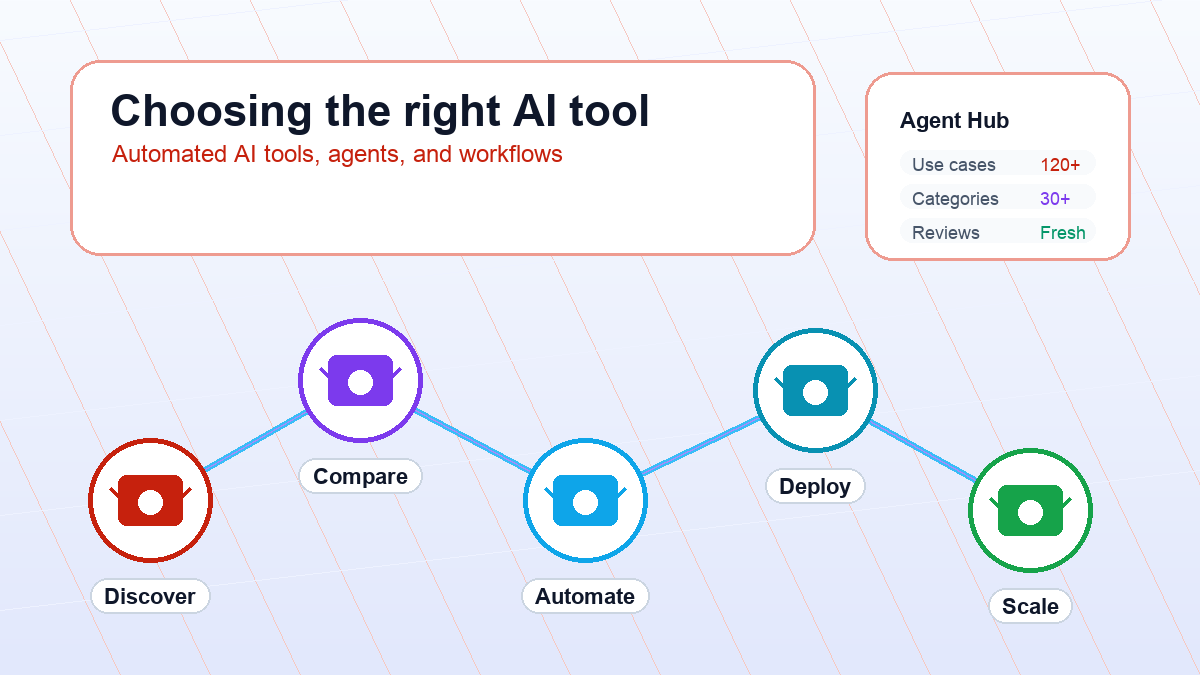
Choosing an AI tool is harder than it looks because most tools describe themselves in the same language. They save time, create content, automate work, improve productivity, and help teams move faster. That may all be true, but it does not help you decide what to buy, what to test, and what to ignore.
A better method is to start with the workflow. What job do you want to improve? Who owns it? Which systems are involved? What does a good result look like? A directory like TopAIAgentsHub is useful because it lets you browse categories and compare options, but the best tool is the one that fits a real work pattern, not the one with the cleanest demo video.
Define the job before you search
Start with one sentence: “We need help with…” Make it concrete. “We need help writing” is too broad. “We need help turning support call notes into clean follow-up emails” is useful. “We need automation” is broad. “We need a tool that reads supplier emails, extracts order changes, and drafts replies for approval” is useful.
This step prevents tool drift. Without a clear job, teams sign up for five products, try each for two days, and forget why they started. A clear job gives you a test case. It also exposes whether you need a simple tool, a workflow automation product, or a custom agent.
Write down the user, input, output, review step, and success measure. If you cannot describe those five things, pause the search. The problem is not the market. The problem is that the workflow has not been defined yet.
Use categories as a map, not a shopping list
AI categories are helpful when they narrow the search. TopAIAgentsHub lists categories such as writing and web SEO, image generators, chat assistants, video generators, e-commerce, HR, email, productivity, files and spreadsheets, developer tools, business, automation, and AI agents. Browse the AI categories page to understand the field, then shortlist tools that match your workflow.
Do not assume the category name tells the whole story. A productivity tool may solve a sales follow-up problem. A file and spreadsheet tool may be better for operations reporting than a general chatbot. A developer tool may be useful for internal automation even if the end user is not an engineer.
Categories should give you a starting set of options. Your workflow should make the final decision. If none of the category tools fit the workflow because your rules, systems, or approvals are too specific, that is a sign to consider a custom build.
Check the data and integration fit
Every AI tool needs input. The question is whether your team can provide that input safely and reliably. If the tool works only when someone copies and pastes data manually, it may be fine for occasional work but weak for daily operations. If it connects to your systems, ask what it can read, what it can write, how permissions work, and whether actions are logged.
For business workflows, integration fit often matters more than model quality. A decent model connected to the right context can beat a powerful model trapped in a blank chat box. If the tool needs customer records, order details, product data, policies, or files, test how well it retrieves and uses that context.
Security also belongs here. Do not paste sensitive data into a tool until you understand retention, access controls, admin settings, and export options. For regulated or operational work, keep human approval in the loop until the controls are proven.
Run a small test with real work
Testing with toy prompts gives toy answers. Pick five to ten real examples from the workflow. Use messy inputs, not polished samples. Include edge cases: missing data, unclear instructions, conflicting files, and a request that should be rejected. A tool that handles clean examples but falls apart on real work will create rework later.
Score the test in plain terms. Did it save time? Did the output need heavy editing? Did it miss important context? Could a new team member use it without a long explanation? Did it fit how the team already works? These questions are more useful than asking whether the tool felt impressive.
Keep the test short. A one-week pilot with real examples is usually enough to decide whether to continue, pause, or try a different category. Long pilots often hide the fact that nobody knows what success looks like.
Ask the actual users to score the output, not just the buyer or the person leading the AI project. The people doing the work will notice small problems that a demo misses: a field in the wrong format, a summary that is too long, a missing approval step, or an export that cannot be used by the next system. Those small details decide whether the tool becomes part of the workflow or another subscription nobody opens.
Know when a custom agent is the better answer
Off-the-shelf tools are best when the workflow is common. Writing a product description, summarizing a meeting, creating an image, transcribing audio, searching documents, or generating code snippets are common enough that existing products may work well. Buy those first unless there is a strong reason not to.
A custom agent makes sense when the workflow is specific to your business. If the tool has to understand your approval chain, your operating rules, your data sources, and your exception language, a generic product may only solve 40 percent of the work. The remaining 60 percent is where teams lose time.
The Build a Custom Agent option exists for that gap. Use it when the job is important, repeatable, and tied to systems that generic tools cannot coordinate cleanly. Start with a small workflow and build from there.
FAQ
What is the easiest way to shortlist AI tools?
Define the workflow first, then browse categories that match the job. Pick tools that can handle your real inputs and review process.
How many tools should we test?
Test three to five serious options. More than that usually means the workflow is still too vague.
Should we choose the tool with the best model?
Not always. For business workflows, integrations, permissions, context, and review controls often matter more than the model name.
When should we stop testing and build?
Consider building when every tool needs too much manual work, cannot connect to key systems, or cannot follow your business rules safely.